Cortex - AI-Native Judicial Intelligence Platform
Designing a fully on-premise AI platform for Basel Court, where every claim must be traceable, every action auditable, and every decision stays human.
Case Study in progress…

End-to-End Product Designer
3 Months+
Desktop Web - 1440px+
UX Research and Testing
AI Prototyping
Design System
Developer Handoff
Challenge
Basel Court processes 300-500 pages per case. Judges spend the majority of their time on work that doesn't require judicial expertise, searching documents, cross-referencing witness statements, manually looking up laws.
AI could change this. But judicial institutions are not startups. Every output must be traceable. Every action auditable. Nothing can leave the court's infrastructure. And the AI must never make a decision, it must support human judgment, not replace it.
There was no existing digital AI tooling at the court. This was greenfield.
Projected Results
Still in progress but we predict after delivery the platform will save 4 hours average reading time per case, +50% contradictions identified across witness statements, and +50% hidden entity connections discovered across historical cases.
Process
Requirements & Competitor Analysis
Before design began, the development team had already defined the core technical direction. The platform would sync with Alfresco, the court's existing Document Management System, read-only, in real time. No writing back. Alfresco remained the source of truth. Cortex would pull from it, never push to it.
Four features had also been scoped prior to our involvement: Smart Abstract, Contradiction Finder, Deep Pattern Recognition, and Translation. The business case was clear, these four capabilities alone would dramatically reduce the manual workload judges faced daily. What wasn't defined was how a judge would actually interact with them, how outputs would be presented, how trust would be established, and how the platform would hold up under the accountability standards of a Swiss judicial institution.
Our job was not to invent the product. It was to make it usable, trustworthy, and defensible, for users where the cost of getting it wrong is a miscarriage of justice.
LawLink was the sixth agent, added during our design process as a direct response to research findings that legal cross-referencing was one of the highest-friction tasks in a judge's daily workflow.

We audited existing judicial AI solutions. Thomson Reuters Westlaw is the dominant player, powerful and trusted, but built for legal research, not case intelligence. It answers legal questions. It does not help a judge work through 400 pages of documents, find contradictions across witness statements, or surface hidden connections between cases. It also runs in the cloud, a non-starter for Basel Court.
Libratech.ai represents the newer wave of AI-native legal tooling, faster, more conversational, built around document interaction. But it is optimized for lawyers preparing arguments, not judges evaluating evidence. A lawyer can act on a suggestion. A judge must be able to defend every finding under cross-examination.
No existing solution was built for the verification needs of a judge. They were all built for the research needs of a lawyer. That gap defined what Cortex had to be.

Initial Plans for Testing
Three stakeholder alignment workshops with the development team revealed that six AI agents were planned, but none of them would be usable without a layer underneath them that made their outputs trustworthy. Reading the Platform Outline and Requirements Concept documents confirmed it. The capability existed. The trust infrastructure didn't.
We identified that if a judge cannot verify an AI claim in one click, the entire platform fails, regardless of how accurate the AI is.
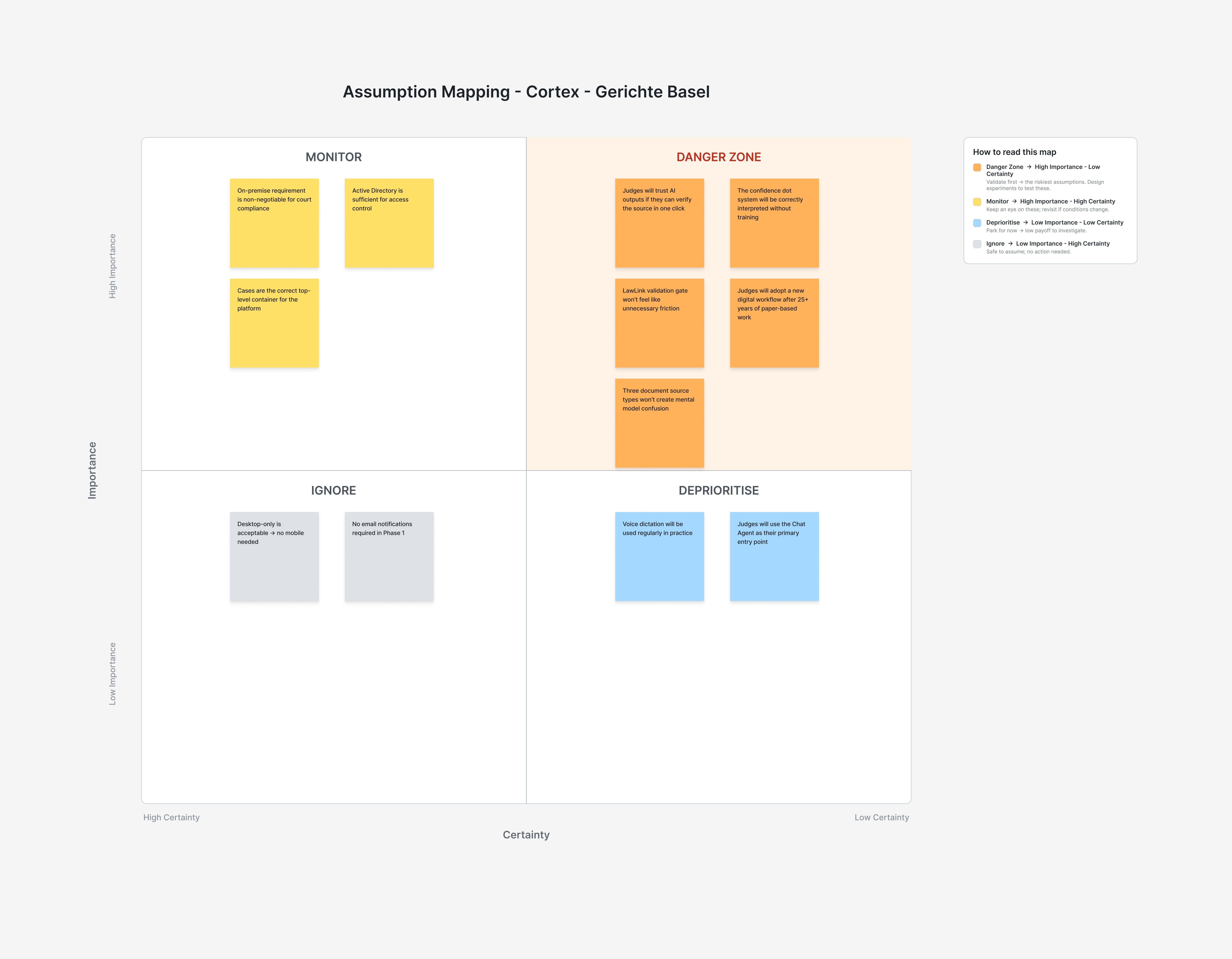
A stakeholder alignment table and assumption mapping 2×2 were the deliverables here. The assumption map placed five unknowns in the danger zone, high importance, low certainty, and these became the research agenda.

Understanding the user
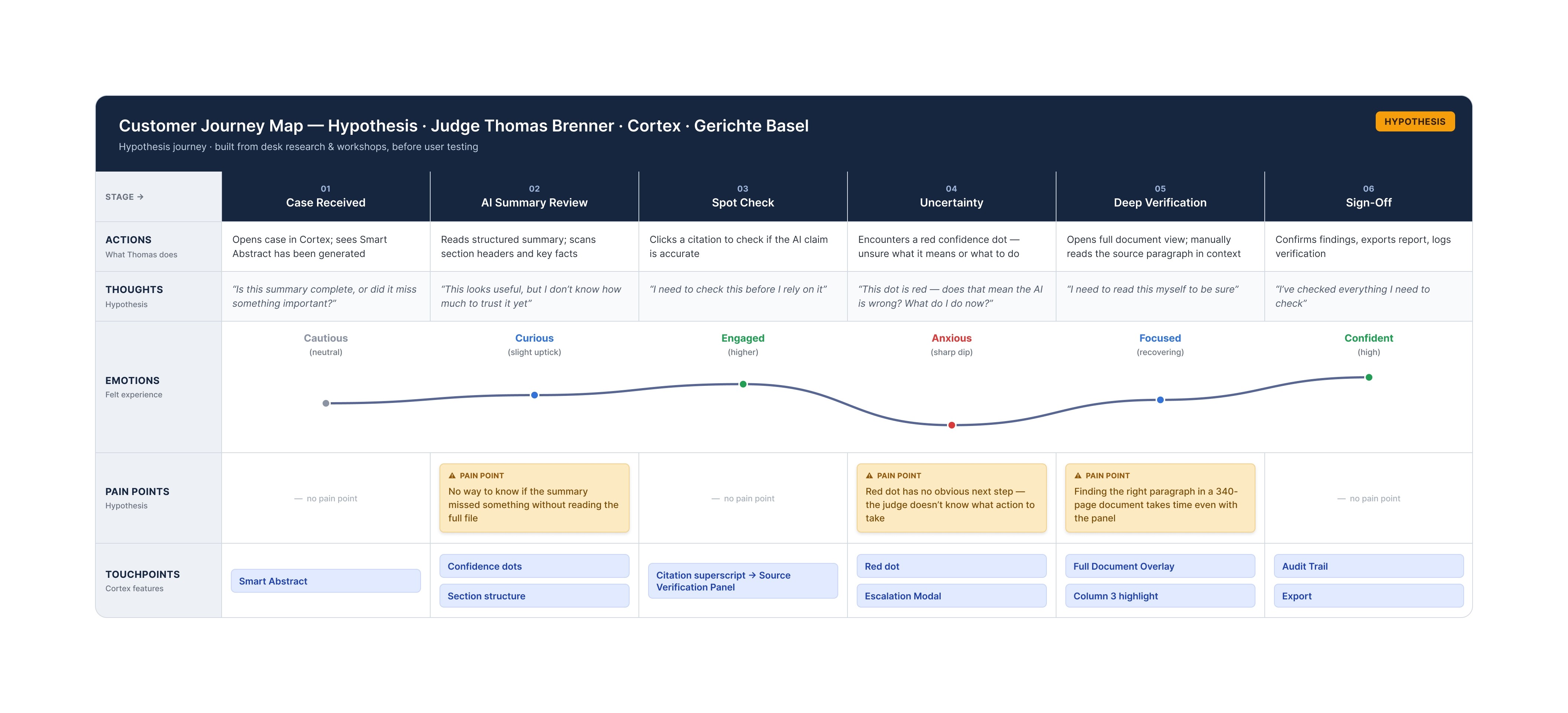
The primary persona was built in two passes in mind. Before interviews: a hypothesis persona based on workshop findings. After a interview session: a validated persona with real frustrations and real behaviours.
The chosen persona: Judge Thomas Brenner (placeholder name for Case Study purposes), 54, Senior Criminal Court Judge, low tech proficiency, 22 years on the bench.
The customer journey map was built in two passes in mind as well. Hypothesis first, then validated after testing. Everything after this phase in the process would be shaped by new findings.

AI Wireframes and prototype
After sketching rough ideas, We utilized Claude Code to generate rapid low-fidelity prototypes, allowing us to move from layout concepts to testable screens in hours rather than days. Three distinct workspace layouts were established and presented to stakeholders for preference testing, variations in how the document panel, agent work area, and source verification panel were arranged and weighted. The three-column layout won decisively, confirming that judges needed documents, work, and verification visible simultaneously without any navigation between them.
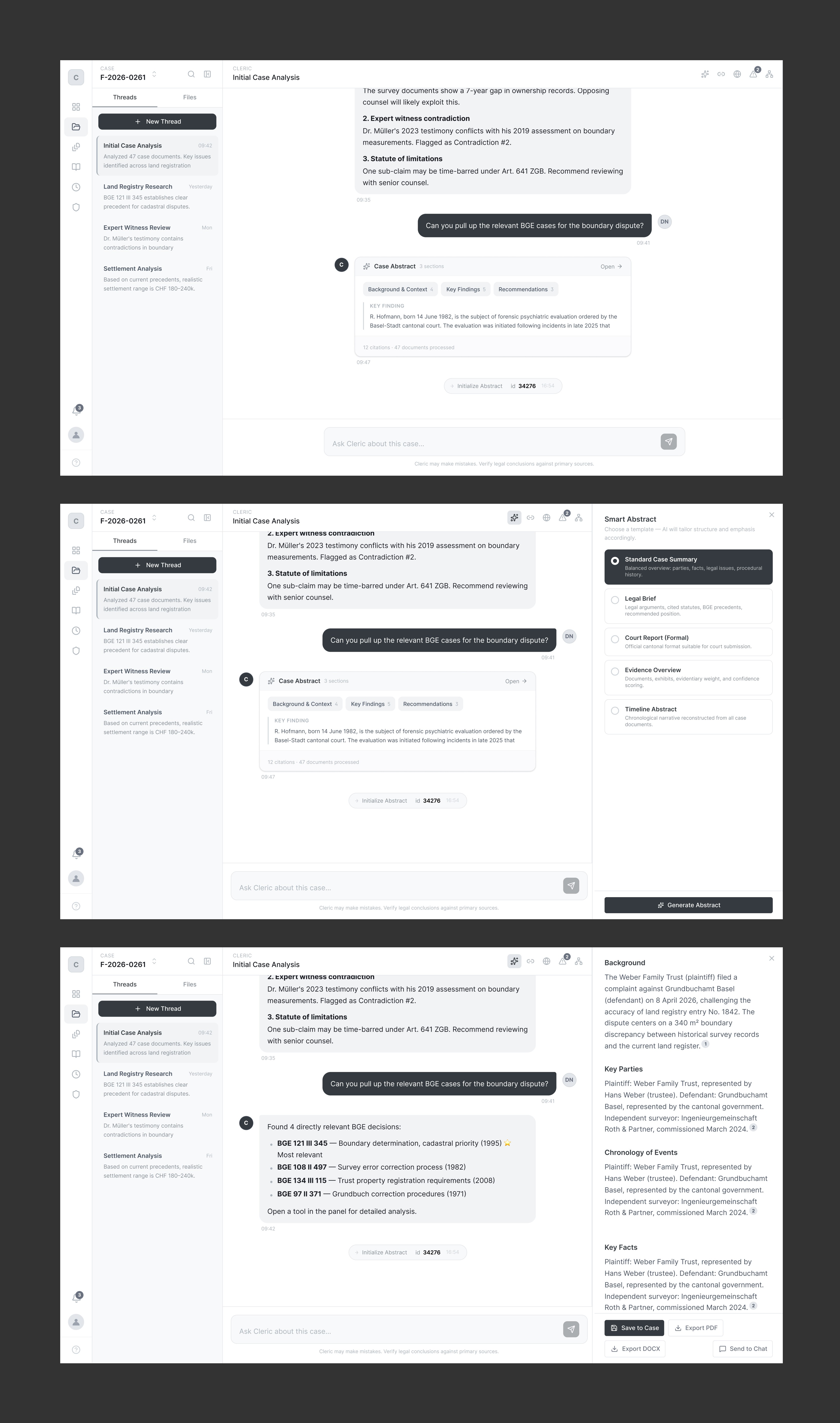
The six agents are the Chat Agent, a conversational interface for querying case documents and dispatching all other tools; LawLink, which matches case offenses to relevant Swiss law articles through a three-step validated flow; Smart Abstract, which generates a structured case summary with every claim linked to its source; Contradiction Finder, which surfaces inconsistencies across witness statements as reviewable side-by-side cards; Deep Pattern Recognition, which maps hidden entity connections across the court's historical database as an interactive graph; and Translation, which handles both quick text snippets and full document translation across the four official Swiss languages.

Sketches with excalidraw

3 layout examples presented in testing, created in ClaudeCode
Law Link

Smart abstract
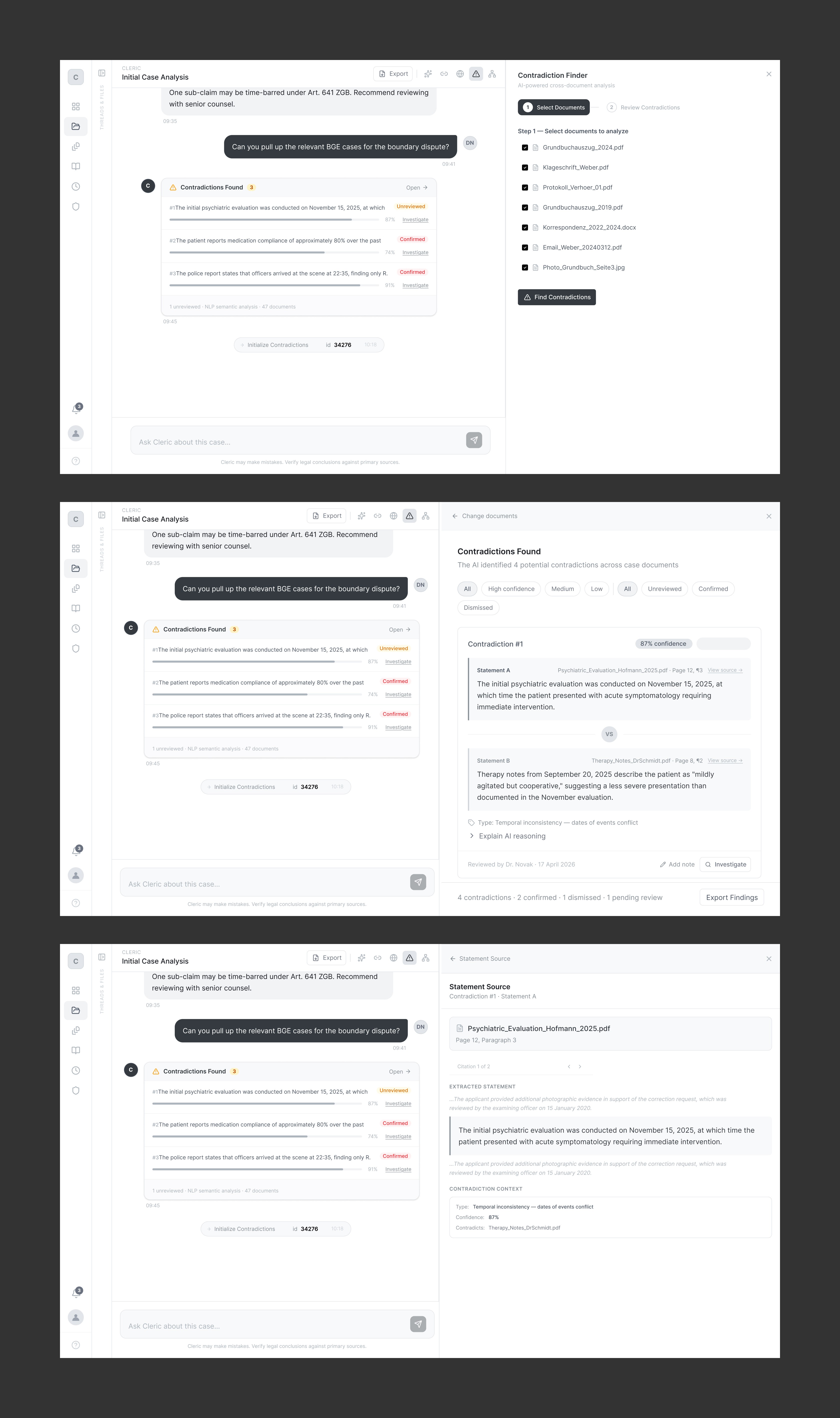
Contradiction Finder

Deep Patterns
Continuation and Conclusion
The platform is currently at prototype stage. User testing with court staff is planned as the next step, the goal is to validate the hypothesis persona and journey map against real judicial workflows and uncover insights we could not surface through workshops and desk research alone. Once testing confirms or challenges our assumptions we will iterate the prototype one final time based on findings before moving into the design system and full production design.
The work so far has been about establishing the right foundation, the right mental model, the right layout, the right trust architecture. What comes next is proving it holds up in the hands of the people it was built for.